Showing posts with label Travel Shandong. Show all posts

Thursday, May 28, 2009

The State Of Shandong


From Beijing, we flied to Dalian then cross over to Shandong Province , the very east province of China. It was one of the early civilization spot of China in stone era and was an important stage for the history of ancient China during Spring Autumn Warring Period. At that time there were 100 over state empires and civil war regularly happened. Qi and Lu which located within Shandong were the two important states among the 7 empires finally left after long period of internal battling. Qi, the strongest state covered huge acres of land along coastal area and north of Tai Mountain ranges, was very rich in natural resources and products. Qi generously was a commercialized and opened society while Lu, a small state almost encircled by Qi, was comparatively conservative. Though different in practices and cultural habits, people were given full freedom to cross states and had own thoughts of philosophies.

It was not a steady and peaceful era but a prosperous literary period. Different stream of pedants started to flourish and branch into 100 over types of lineage in different teachings and thoughts. Confucianism was the major and the main one. Confucius from Lu State was the first to start private school in regardless of ranking and grading and he was also the first philosophy to travel around all empire states to promote his teachings and ideas. Though his thoughts was not successfully accepted and implemented by any empire, it's great influences towards all Chinese from generations to generations was infinitive. On top of it, many well known noble talents, politicians, scholars, artists, military heroes, professional and superior leaders in all areas and sectors were accomplished within this territory at this part of history. The world famous book Soon-Zi Art of War, a bible for politicians and businessmen of today was also written at that time, by Qi general Soon Wu and compiled by his grandson, General Soon Pin.

Qi was the last state to be defeated by Chin 秦 , who unified the 7 state empires into one China in 221 B.C.

Though many historical treasures and valuable remains of Qi and Lu were seriously destroyed and damaged during Chinese 10 yrs cultural revolution, there were still large scale of ancient tombs with relics and remains scattering within the land of Shandong. To understand more about Chinese literal history, Linzi, the town at east of Zibo City of Shandong was a compulsory spot to visit. It was the ancient capital of Qi State Empire for about 800 years and now an "Underground Museum" of today. From its museums and records, we came to know soccer game was originated from here and application of wheels for vehicles had been used 3-4000 yrs ago by ancient Chinese.


Wednesday, May 27, 2009

Fairyland on earth - Yantai


Yantai is coastal city of Shandong Province, formerly known as Zhifu 芝罘 or Chefoo by the west. It was a small fishing village in the past and later became a defensive guard line to protect against Japanese sea-pirates in 13th century. It was converted into a treaty port for British in 19th century when Qing Government lost in opium war and was controlled by German for about 20 years in early 20th. After 1st world war American turned it into a summer station for their entire Asian fleet and Japanese established it into a trade center. Like the other two cities, Wuhai and Qingdao, Yantai also had a colorful history with great influences from the west. Unfortunately, none of these footprints or marks left in the city of today. Most of the buildings are of much more recent origin. Yantai of 21st century, is the biggest fishing seaport and 2nd largest industrial city of Shangdong Province, especially in its agriculture sectors. It is very well-known for its apple and grape winery. As Dalian, Yantai not only is a summer retreat, an ice-free trade port, a robust economic center but also a primary coastal guard point for the nation capital, Beijing.


Peng Lai Ge (蓬莱阁)is a fairyland in Yantai. The sophisticated Wutong bare trees (梧桐树) with its straight trunks and beautifully designed branches, lined up at the entrance of Peng Lai Ge. Botanical name as Sterculia Platanifolia is sometimes addressed as national tree of China. It was said in olden days that Wutong was the only tree that phoenix would rest on. Inscription at the overhead plague of Peng Lai Ge front gate arch was hand written by Song famous poet Su Dong Po (苏东坡) on 11th century. The four Chinese character (人间蓬莱) that read as "ren jian peng lai" literally means fairyland on earth.


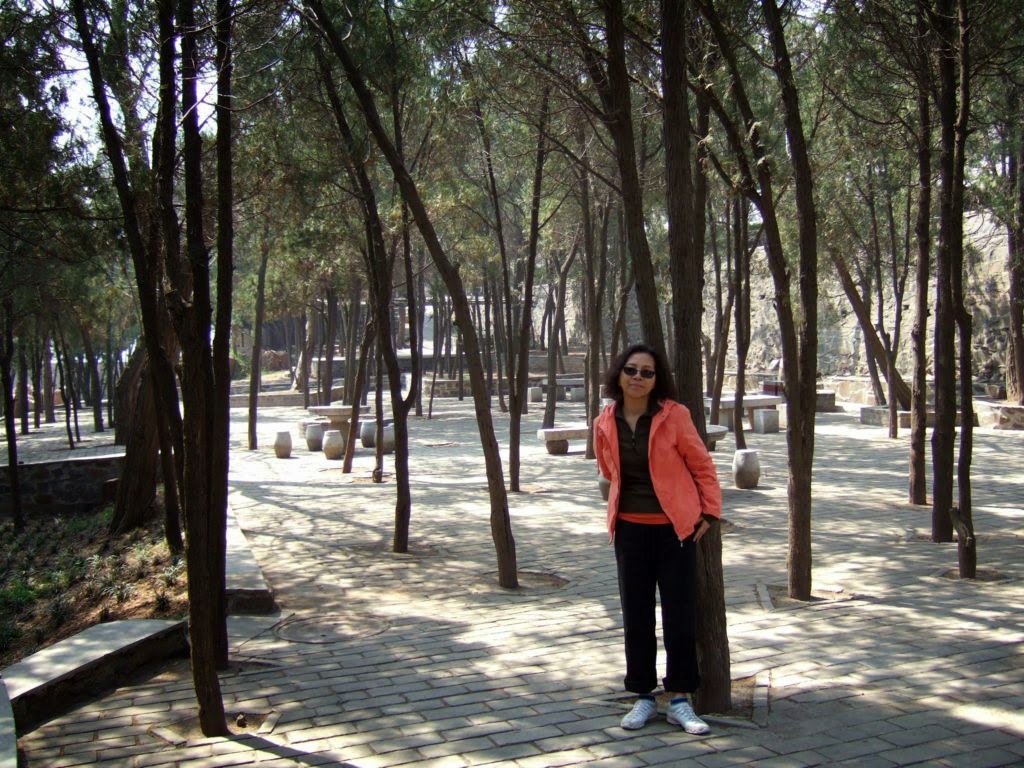
Wooded corner with stone top and stool had been a retreat place of a recluse.


The four Chinese characters (万寿无疆)that carved on the stone tablet, which means boundless longevity was the handwriting of Qing Dynasty second Emperor Kangxi (康熙 1662-1722). The other one I forgot who wrote it.


Original hand writing of Song poet Su Dong Po was the most precious treasure in Peng Lai pavilion. During dynasty of Song, Ming and Chin, many literary men, scholars liked to gather at this fairy land next to Bo Sea, thus leaving behind many poetries, phraseology, calligraphy, paintings on stone or plague or votive tablets which now became the valuable collection of Chinese literature culture.


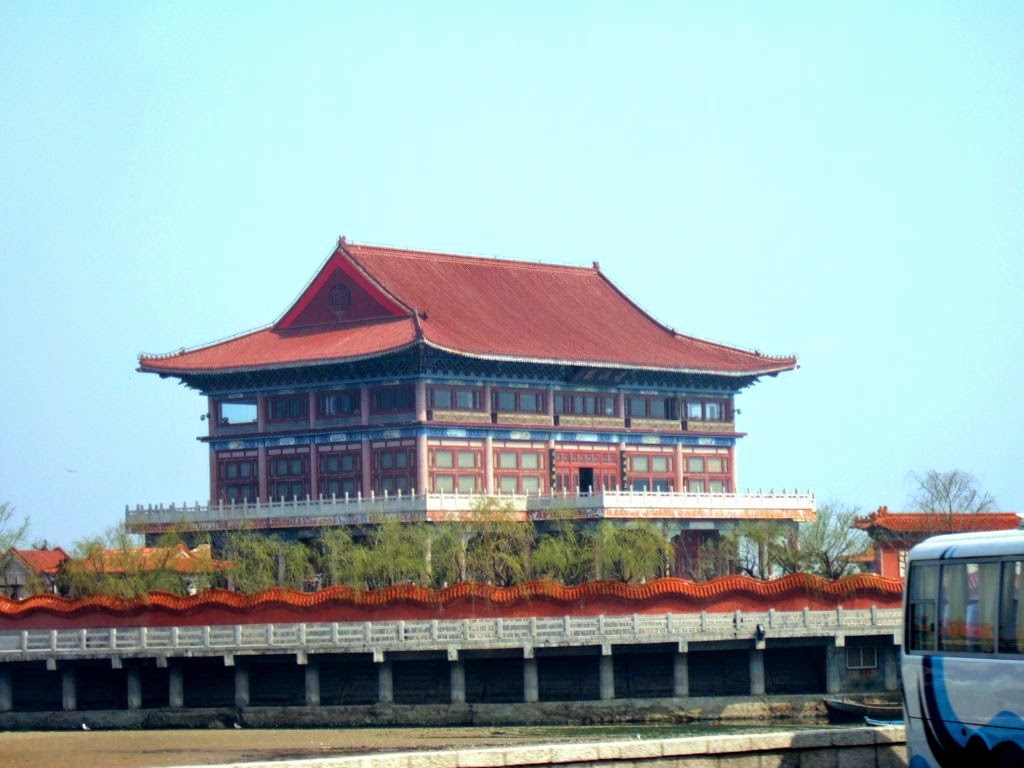
Six groups of dwelling remained today at Peng Lai were either constructed, extended or renovated during the last 3 dynasties - Song, Ming and Qing. Its temples, shrines, pavilions, kiosks, platforms, towers or terraces were built to be perfectly merged into nature, echoed and reflected from mountains with sea. Main shrine at Peng Lai Pavilion (蓬莱阁)and structures at Dan Cliff Fairyland (丹崖仙境) are two of them .


The main building was first built in year 1061 but the present one was restored in 1819.


The name Peng Lai (fairyland) was given by Emperor Hang Wu Ti in early 7th century but pavilion was built in 1061. It shared equivalent fame with the other 3 ancient pavilions: Yellow Crane Tower (黄鹤楼), Yue Yang Tower (岳阳楼), and Teng Wan Pavilion (滕王阁) and was the only one built on the mountain cliff by the side of sea. Peng Lai was taken as a fairyland since Hang Dynasty as from certain angle of the mountain, many people of olden days eye-witnessed sea mirage on Bo Sea and some believed that this illusive appearance were fairies. Thus fairy legends were delivered down from generations to generations. Majority of the buildings were of distinctive peculiarities, locating at a remarkable scenic position. It was indeed a fairy land.


Pretty little theatrical stage was of ancient original construction.


The tales about how 8 immortals riding on the wind, breaking through the wave to cross over rough sea, was the most popular legend in Taoism. It was said that Peng Lai Dan Cliff was the departure point of the 8 immortals on their trip to the conference of the Magical Peach. It was a happy story that used to be repeatedly played in Chinese opera house..even till today.


The Ming famous General Qi Ji Guang 戚继光 (1527-1588)was a literary military profession。 He trained and educated his navy into the most disciplined, organized and strong troops in the inner sea of Water Force City, never failed in any battle against the intruders. Two of his written books about military regime and strategy, are among the 10 Chinese military tactics books in China. (L) A view of Yellow Sea from the fort of Water Force City.


The huge sculpture of 8 immortals.


The prefecture at south including residence of chief commander at Zhen Yang Gate (振阳门), the only area that linked to the land, was no more of original buildings. Souvenir sold at the stalls are mainly wooden calabash which is a symbol of longevity.


In front of bridge was the original Ming constructed stone wall at North Gate and the sea spot where Ming General Qi Ji Guang (戚继光) trained his navy troops


Water Force City covered an area of 250,000 sq. ft. had two main gates. Water gate at north was the canal for Yellow Sea water to channel into the inner bay forming a small sea of about 70,000 sq. ft at that time. It was a parking dock for warships and vessels in Ming Dynasty.


Water Force City was a natural sea bay at east of Peng Lai Pavilion with only one outlet leading to Yellow Sea. Initially it was only a water stockade defending against Kitan Tartars from north but later strengthen with stone wall, dock, and cannon fort in 14th to 15th century to defend against intruders as well as sea pirates. It was the only complete navy base left from the past in China.


Ancient war ship of Yuan Dynasty dug out from Water Force City when clearing sea-bed silt in 1984


Visiting a knife manufacturer on the way to Qingdao.